

Comparing Traditional and Smart Sirens in Security Systems and Fire Alarms: A Buyer’s Guide
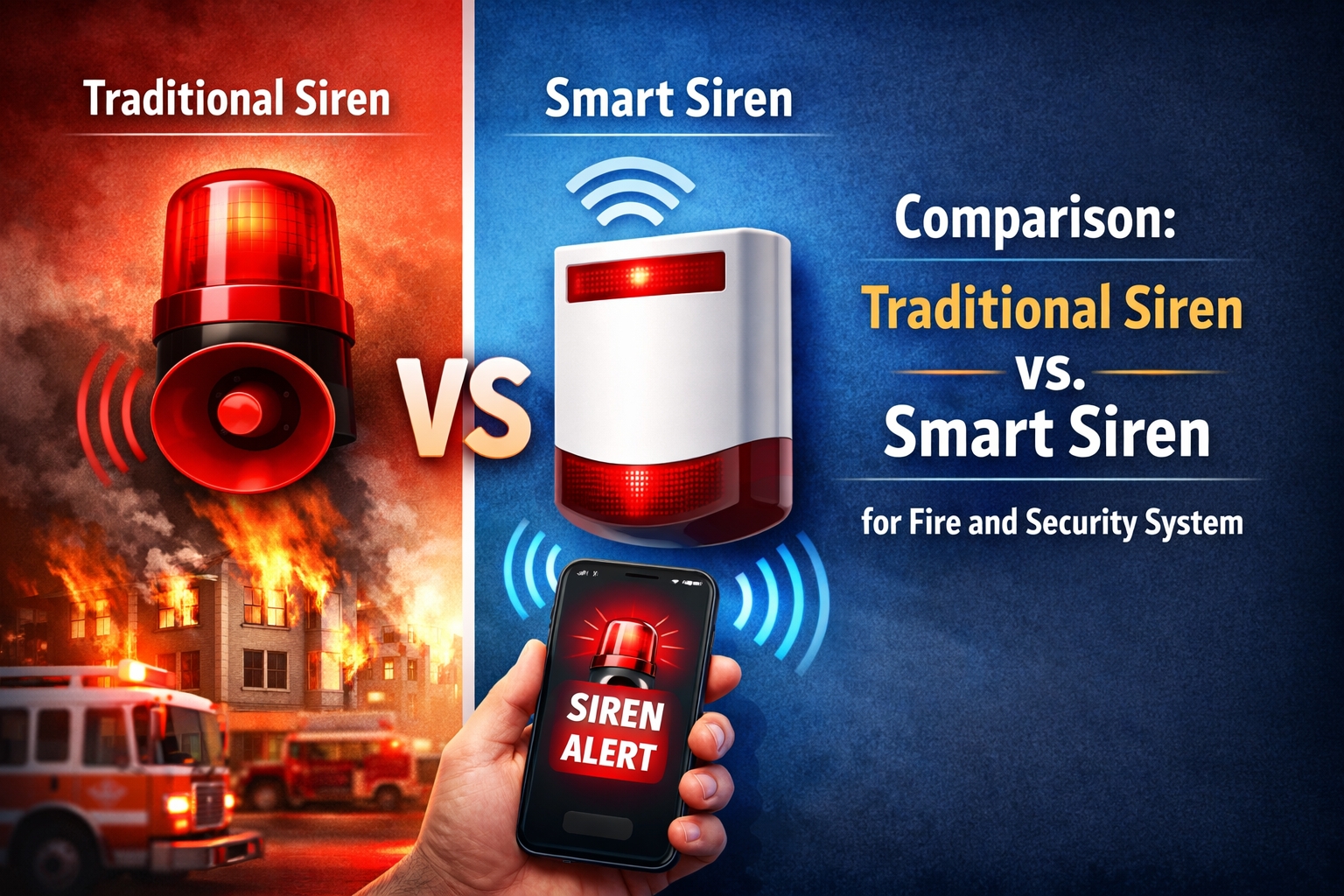
In professional security and fire alarm systems, sirens are not merely alert devices—they are critical safety components that influence system integration, scalability, response time compliance, and total cost of ownership. For buyers such as security system integrators, property developers, facility managers, and ODM/OEM manufacturers, choosing between traditional sirens and smart sirens has long-term implications in relations to finances & operations.
As infrastructure evolves toward connected and robust security systems, smart sirens are gaining traction. Nonetheless, traditional sirens continue to play an important role in environments where reliability, simplicity, and regulatory compliance remain top priorities.
Here we outline technical and commercial comparison of traditional and smart sirens, helping buyers make informed decisions based on performance, integration capability, cost structure, and future readiness.
Understanding Sirens in Professional Security and Fire Alarm Systems
Sirens act as the final warning notification layer in a security system or fire alarm system. Upon triggering by movement, smoke detection, temperature increase, or gas concentration, the siren will:
- Deliver warning alert
- Generate loud sound pressure
- Operate reliably under emergency and time-sensitive conditions
- Integrate and communicate with the control system
In commercial and industrial settings, sirens are often deployed and widespread, making maintenance, standardization, and lifecycle & costs key considerations.
What Are Traditional Sirens?
Traditional sirens are hard-wired audible alarm devices connected directly to a central alarm control panel or security control unit. These are often 12V or 24V DC.
Core Attributes
- Consistent sound tone and volume output
- No cloud network dependency
- Direct electrical power
- Long service life with minimal configuration required
These traditional types are commonly used in:
- Legacy buildings
- Industrial plants
- Commercial warehouses and logistics hubs
- Other high-risk environments requiring reliable local alerts
What Are Smart Sirens?
Smart sirens are network-connected alarm devices designed to operate within security or fire alarm ecosystems.
Core Attributes
- Can be wired or wireless with network connectivity
- Integrated with building management systems (BMS)
- Remote notification, monitoring and diagnostics
- Configurable settings and automation
Smart sirens are increasingly adopted in:
- Smart buildings
- Heritage sites and historic buildings
- Smart city deployment
- Enterprise security settings
- Integrated fire and security platforms
Technical Comparison: Traditional vs. Smart Sirens
Main Feature Comparison
|
Feature |
Traditional Sirens |
Smart Sirens |
|
Trigger Mechanism |
Battery or AC mains |
Battery or AC mains |
|
Connectivity |
None |
Cellular, Bluetooth, Wi-Fi, Zigbee, Z-Wave |
|
Sound Customization |
Manually |
Possible |
|
Remote Monitoring |
No |
Yes |
|
System Integration |
Limited |
Extensive |
|
Firmware Updates |
Hardware change |
Over-the-air (OTA) possible |
|
Event Logging |
No |
Yes |
|
Scalability |
By wire |
By wireless network |
Reliability and Performance in Commercial Environments
Traditional Sirens
From a reliability standpoint, traditional sirens ensure maximum predictability and operational awareness. They are not affected by:
- Network outages
- Cybersecurity risks
- Software failures
This makes them suitable for mission-critical operations where uninterrupted connection and alerting is essential.
Smart Sirens
Meanwhile, smart sirens enhance performance by extending alerts beyond the physical site to other connected devices. In addition to sounding alarms, they can:
- Notify security teams remotely with cloud connection
- Trigger automated workflows & processes
- Interface with emergency response center
Some enterprise-grade smart sirens incorporates fallback modes that ensure alarms still sound even with lost connectivity.
Installation, Placement, and Maintenance
Traditional Sirens
- Require physical wiring & site inspection
- Typically installed by certified electricians
- Maintenance involves physical inspection and testing
Smart Sirens
- Wireless or hybrid installation options
- Quicker deployment across large buildings
- Less to no damage to the infrastructure
- Automated monitoring and fault notifications
For organizations managing multiple locations, smart sirens significantly reduce maintenance labor costs.
Cost Comparison
Cost Comparison over Product Lifecycle
|
Associated Cost |
Traditional Sirens |
Smart Sirens |
|
Product Unit Cost |
Low |
Medium–High |
|
Installation Cost |
Medium |
Low–Medium |
|
Maintenance Cost |
Medium |
Low |
|
Expansion Cost |
High |
Low |
|
Subscription Cost |
None |
Optional |
Compliance and Certification
Both traditional and smart sirens are capable of complying with:
- Fire safety & security intrusion regulations
- Occupational safety & hazard standards
- Local commercial building codes
But smart sirens offer additional conformity advantages such as:
- Digital test logs
- Remote fault monitoring
- Automated reporting
These features simplify inspections and documentation for regulated industries.
Use Case and Comparison
Table 3: Best Use Case Comparison
|
Use Case |
Traditional Sirens |
Smart Sirens |
|
Industrial settings |
✔✔✔ |
✔✔ |
|
Commercial Offices |
✔✔ |
✔✔✔ |
|
Warehouses |
✔✔✔ |
✔✔✔ |
|
Multi-Site Enterprises |
✔ |
✔✔✔ |
|
Smart IoT Buildings |
✖ |
✔✔✔ |
|
Budget-Limited Projects |
✔✔✔ |
✔ |
Future-Proofing Fire and Security Alarm Systems
Smart sirens are better positioned to support:
- AI-driven alarm notification and verification
- Predictive monitoring and maintenance
- Scalable enterprise-wide deployments
Conclusion
Traditional sirens remain a time-tested and dependable solution for reliable security and fire alarm deployments. However, for organizations or buildings seeking scalable, flexible, and data-driven security infrastructure, smart sirens offer a better investment.
For any inquiry or alarm development projects, please contact our product specialists for more information.

TEL: 886-2-2708-5151 FAX: 886-2-2703-5588 Email: info@keysecurity.com.tw